
Trinity Court Records After Arrest
Trinity Superior Court is the local criminal court for charges that follow a Trinity County arrest. The criminal division describes a criminal action as the process by which a person accused of a crime is charged and brought to trial. That matters because the jail booking record and the court record are related, but they are not the same record. Booking shows the arrest event, custody status, bail or hold information, and jail intake facts. Court records show the filed case, the charges selected by the prosecutor, hearing dates, and later case outcomes.
The arrest to court flow is local and direct. A person is arrested, transported to the Trinity County Correctional Facility, and booked. Intake includes classification, property handling, medical or mental-health screening, and a custody or release review. The Trinity inmate handbook says new arrests or new charges generally go to court within two days, excluding weekends and holidays. After reports are sent for prosecution review, the District Attorney decides whether the evidence supports filing a case. Once filed, the case belongs in the court record.
For custody and booking detail, use Trinity County jail inmate records. For booking photo questions, use Trinity County jail mugshots. Court records after a jail arrest are the next step in the same event, focused on the case rather than the jail entry.
The Trinity Superior Court criminal division gives the best official overview of local criminal case handling.
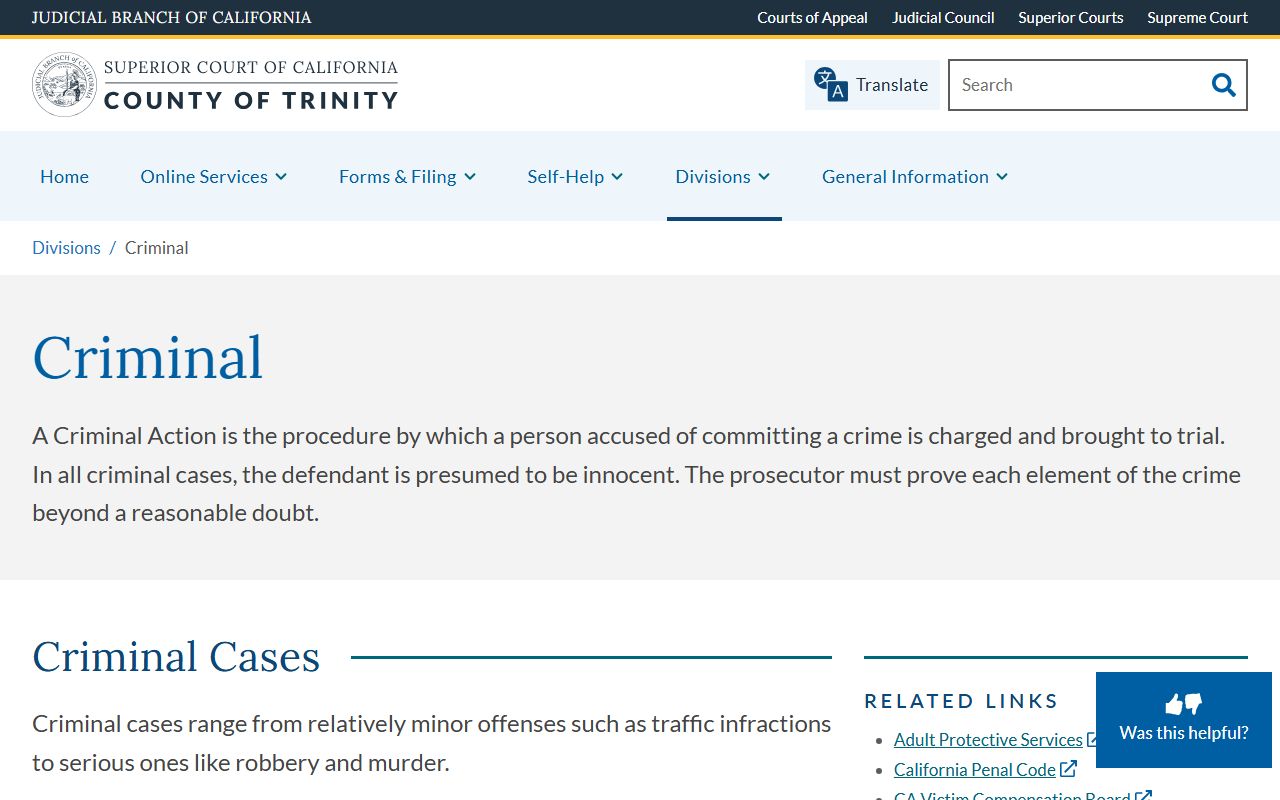
The criminal division source is useful because it separates accusations, required appearances, bench warrants, and the prosecutor's burden of proof.
Trinity Court Record Access
No official public Trinity criminal case-search portal was located in the reviewed sources. That changes the search path. Instead of starting with a defendant-name case index, start with the jail or booking facts, then use the weekly calendars and clerk contact to identify the first appearance or next hearing. The courthouse is at 11 Court Street, Weaverville, CA 96093, and the clerk's phone number is 530-623-1208.
The court's online services page points users to calendars, ticket payments, jury service, and other tools, but the researched material did not show a searchable criminal case docket for the public. When a case is old, missing from a weekly calendar, or not clear from the name alone, the clerk is the local access point for file-review and copy procedures. Use the person's full name, date of birth if known, case number if known, and hearing date if known.
| Official Channel | Search Fields | Use | Limits |
|---|---|---|---|
| Trinity court site search | Search text | Find court pages and notices | Not a criminal case lookup |
| Court calendars | None visible | Check weekly hearing lists | No defendant-name portal found |
| Clerk contact | Name, case number, hearing date | Ask about filed charges and files | Some records need in-person review |
| ePay ticket portal | Citation or case number | Traffic and payment routing | Not a full criminal docket |
The Trinity Superior Court calendars are the main online court-record channel found for recent hearings.
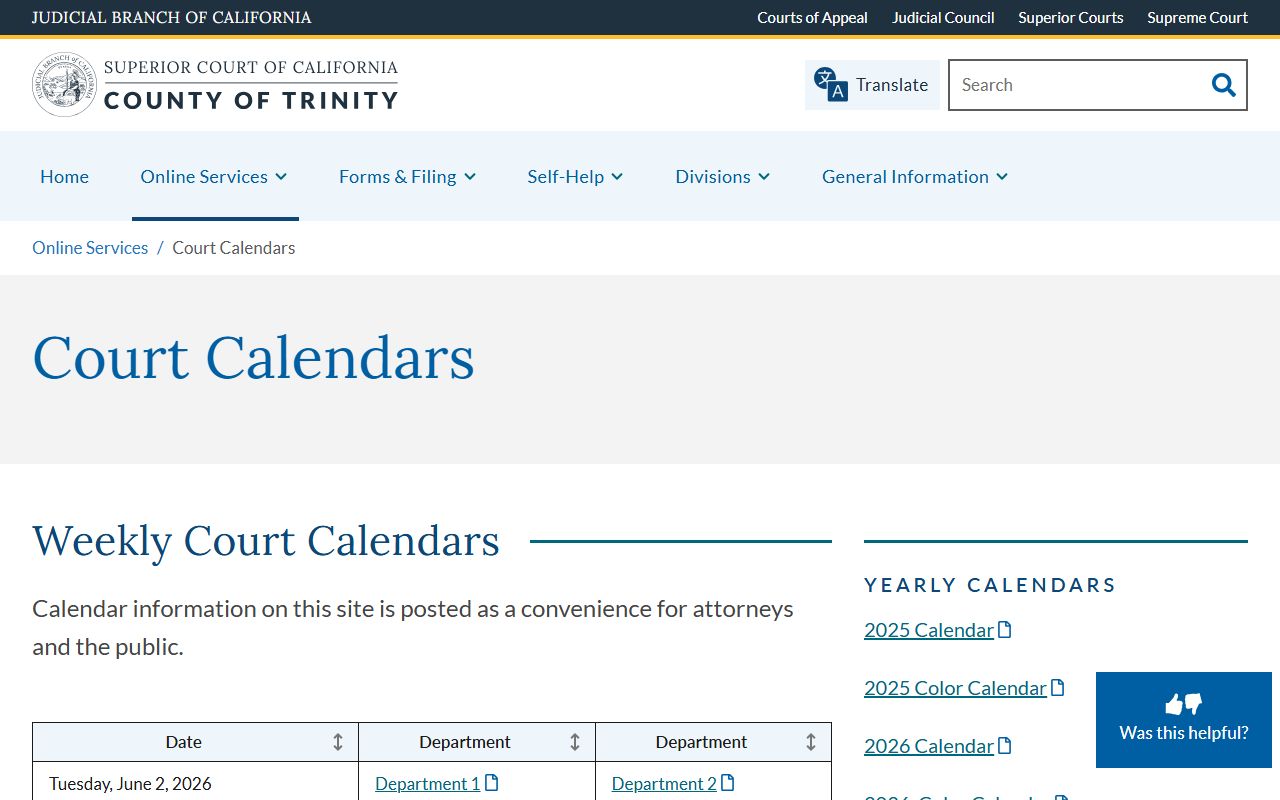
The calendar format fits first-appearance checks after a jail arrest, but it should be paired with clerk contact when the charge list or case status is unclear.
Trinity Arrest Charging Documents
Only the State, through the District Attorney in each county, can charge people with criminal violations. In Trinity County, the District Attorney's Office reviews reports from agencies such as the Sheriff's Department, California Highway Patrol, U.S. Forest Service, CalFIRE, California Department of Fish and Wildlife, and protective services agencies. A report may be forwarded, reviewed, declined, or filed. The court record starts when a charging document is filed, not when a person is merely booked into jail.
The common words can be confusing. A complaint is the usual early charging document in many criminal cases. An information is a prosecutor-filed felony charging document used after required pretrial procedure. An indictment is returned through a grand jury process. The exact document used depends on the case, but all three serve the same broad purpose: they state the formal accusations that become the court record after an arrest.
| Document | Who Files It | Common Use | What It Means |
|---|---|---|---|
| Complaint | Prosecutor | Early misdemeanor or felony filing | Opens the criminal case and lists charges |
| Information | Prosecutor | Felony case after preliminary steps | States charges that move forward in court |
| Indictment | Grand jury | Less common serious-case route | Accuses a person after grand jury review |
The Trinity County District Attorney is led by District Attorney David M. Brady, with Deputy District Attorney Raymond Yeung listed by the county. The office phone is 530-623-1304. Its public counter walk-up assistance is listed for 8 AM to noon, while office hours are Monday through Friday, 8 AM to 5 PM, closed county holidays.
Trinity Charge Status Records
Jail booking charges can differ from the charges that appear later in Trinity County court records after an arrest. Booking charges are tied to the arrest and intake process. Filed charges reflect the prosecutor's review of reports, witness information, legal elements, and proof. A charge can be added, amended, reduced, dismissed, or resolved by plea or trial. A person remains presumed innocent unless a conviction is entered.
| Status | What It Means | What to Check |
|---|---|---|
| Pending | The charge has been filed and has not reached a final result. | Next calendar date and custody status |
| Amended | The charge text, level, or code has changed after filing. | Latest complaint, information, or minute order |
| Reduced | A more serious charge was lowered to a lesser charge. | Plea entry, order, or updated charge list |
| Dismissed | The charge was dropped by court order or prosecution action. | Dismissal date and whether other counts remain |
| Convicted | The case ended in a guilty plea, verdict, or other conviction. | Sentence, fines, probation, jail, or CDCR transfer |
Traffic and some payment matters may route through the court's pay tickets online page, which references citation or case number use. Misdemeanor and felony fines are not the same as a full criminal case search.
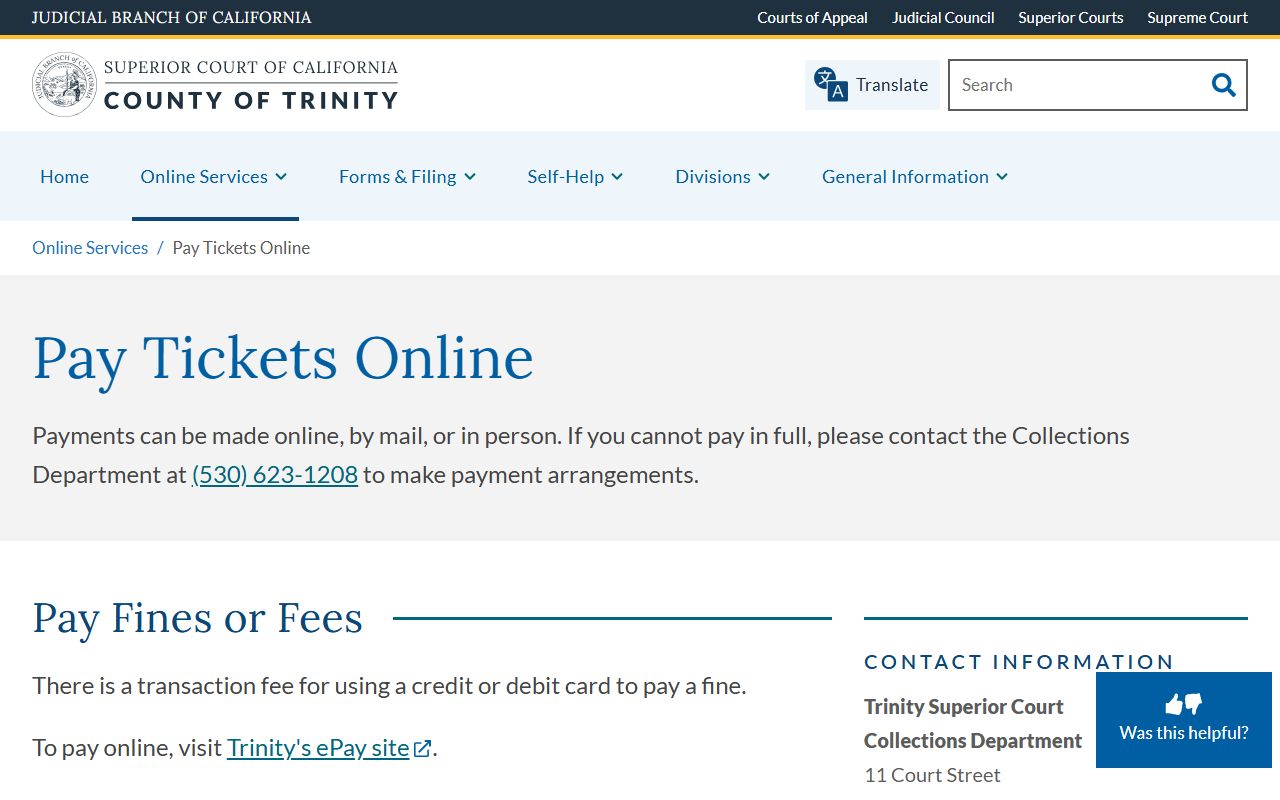
The payment page helps when a citation or case number is already known, but charge status still depends on the court file and hearing record.
Trinity Arrest Bond Records
Trinity's reviewed materials do not publish a standalone public bail schedule or bond-posting page. The custody manual does document release routes, including bail, own recognizance release, citation release, and Penal Code 849(b) release. It also says an inmate may use personal funds for bail by signing a property release form, after the on-duty supervisor receives the transaction document and the account can be debited.
Bond records after an arrest should be read with holds in mind. A person may have money available for bail and still remain in custody because of another warrant, court order, probation or parole hold, detainer, or non-bailable status. Call the Trinity County Correctional Facility at 530-623-8124 for current release routing, then verify the next court date with Trinity Superior Court.
- Cash bail
- Money posted directly to secure release while the case remains active.
- Surety bond
- A licensed California bail agent posts bond and charges a fee.
- Own recognizance
- Release based on a promise to appear, without posting cash bail.
- No-bond hold
- Custody continues because release is barred or another agency or court hold exists.
Trinity Arrest Warrant Records
No official Trinity Sheriff active-warrant search, warrant list, or most-wanted page was located. The strongest official warrant guidance comes from the court. The criminal division says a judge may issue a bench warrant if a person misses a scheduled appearance. Other court pages note that failure to appear, pay, or comply can also lead to a warrant in the right type of case.
For a bench warrant tied to court records after an arrest, contact the clerk at 530-623-1208 or speak with an attorney. For records routing, the Sheriff's Records Lobby can be reached at 530-623-2611. A March 2026 sheriff notice warned that deputies do not call to demand warrant or citation payment by phone, so payment-demand calls should be verified through official numbers.
- Arrest warrant: a court order authorizing arrest based on alleged offense or probable cause.
- Bench warrant: a judge-issued warrant, often from missed court or failure to comply.
- Search warrant: authority to search a place, person, or property, not a custody lookup tool.
- Fugitive hold: a hold for another county, state, or federal agency.
Trinity Charges Versus Convictions
A charge is an accusation. A conviction is a final result reached by plea, verdict, or other qualifying adjudication. Trinity Superior Court's criminal page states that a defendant is presumed innocent and that the prosecutor must prove each element beyond a reasonable doubt. This distinction is central when reading court records after a jail arrest because early records may show only claims that still have to be proved.
| Charge | Conviction | |
|---|---|---|
| Stage | Filed accusation | Final or qualifying case result |
| Proof | Based on reports and filing review | Beyond reasonable doubt or plea admission |
| Record Meaning | Shows what was alleged | Shows legal responsibility was found |
| Can Change | May be amended, reduced, or dismissed | May affect sentence, probation, jail, or prison |
Trinity Sealed Arrest Records
California law treats sealing and post-conviction relief as different tools. Penal Code 851.91 allows a person whose arrest did not result in conviction to petition to seal arrest and related records, subject to exceptions and procedure. Expungement is a common public term, but in California many people are really asking about dismissal, sealing, or other relief that changes access and reporting rather than erasing every trace from every agency system.
| Sealed | Expunged or Dismissed | |
|---|---|---|
| Main Effect | Limits public access to arrest-related records | Changes the court disposition or reporting status |
| Common Trigger | No conviction from the arrest | Eligible conviction or completed case relief |
| Agency Access | Some justice agencies may retain limited access | Not the same as physical destruction |
| Where to Start | Court petition or legal counsel | Court file, disposition, and eligibility review |
Restricted Trinity Court Records
Not every record tied to an arrest is public. The California Public Records Act includes broad access rules, but law-enforcement and court records have limits. Government Code 7923.610 requires release of listed arrestee information, including name, physical description, arrest and booking times, bail, custody location, charges, warrants, and holds unless safety or investigation exceptions apply. Government Code 7923.600 protects many investigatory, security, and intelligence records from general disclosure.
Juvenile matters are more restricted. Welfare and Institutions Code 827 makes juvenile case files generally confidential and limits inspection to listed people, agencies, or court-authorized access. Victim information, medical information, sealed records, protected safety details, and active investigation material may also be withheld or redacted. For a personal statewide criminal-history review, use the California DOJ Record Review process. DOJ does not process third-party criminal-history requests for casual lookup use.
Important: Public lookup information is not a consumer report and cannot be used for FCRA-covered screening decisions.